
The Ripley Plan.
(© 2026 Trains and Railroads, All Rights Reserved)
THE RIPLEY PLAN
Ripley Plan to consolidate railroads into regional systems
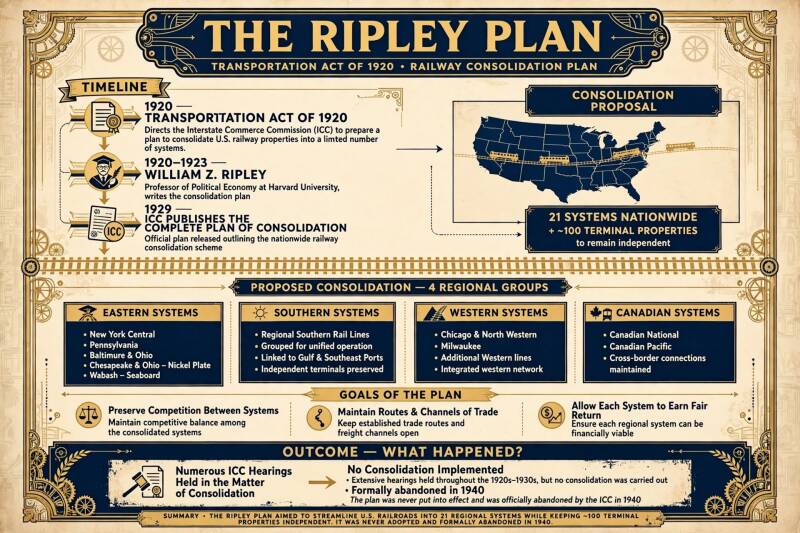
The Transportation Act of 1920 directed the Interstate Commerce Commission to prepare and adopt a plan for the consolidation of the railway properties of the United States into a limited number of systems. Between 1920 and 1923, William Z. Ripley, a professor of political economy at Harvard University, wrote up ICC's plan for the regional consolidation of the U.S. railways. His plan became known as the Ripley Plan. In 1929 the ICC published Ripley's Plan under the title Complete Plan of Consolidation. Numerous hearings were held by ICC regarding the plan under the topic "In the Matter of Consolidation of the Railways of the United States into a Limited Number of Systems".
The proposed 21 regional railroads were as follows:
- Boston and Maine Railroad; Maine Central Railroad; Bangor and Aroostook Railroad; Delaware and Hudson Railway
- New Haven Railroad; New York, Ontario and Western Railway; Lehigh and Hudson River Railway; Lehigh and New England Railroad
- New York Central Railroad; Rutland Railroad; Virginian Railway; Chicago, Attica and Southern Railroad
- Pennsylvania Railroad; Long Island Rail Road
- Baltimore and Ohio Railroad; Central Railroad of New Jersey; Reading Railroad; Buffalo and Susquehanna Railroad; Buffalo, Rochester and Pittsburgh Railway; 50% of Detroit, Toledo and Ironton Railroad; 50% of Detroit and Toledo Shore Line Railroad; 50% of Monon Railroad; Chicago and Alton Railroad (Alton Railroad)
- Chesapeake and Ohio-Nickel Plate Road; Hocking Valley Railway; Erie Railroad; Pere Marquette Railway; Delaware, Lackawanna and Western Railroad; Bessemer and Lake Erie Railroad; Chicago and Illinois Midland Railway; 50% of Detroit and Toledo Shore Line Railroad
- Wabash-Seaboard Air Line Railroad; Lehigh Valley Railroad; Wheeling and Lake Erie Railway; Pittsburgh and West Virginia Railway; Western Maryland Railway; Akron, Canton and Youngstown Railway; Norfolk and Western Railway; 50% of Detroit, Toledo and Ironton Railroad; Toledo, Peoria and Western Railroad; Ann Arbor Railroad; 50% of Winston-Salem Southbound Railway
- Atlantic Coast Line Railroad; Louisville and Nashville Railroad; Nashville, Chattanooga and St. Louis Railway; Clinchfield Railroad; Atlanta, Birmingham and Coast Railroad; Gulf, Mobile and Northern Railroad; New Orleans, Jackson and Great Northern; 25% of Chicago, Indianapolis and Louisville Railway (Monon Railroad); 50% of Winston-Salem Southbound Railway
- Southern Railway; Norfolk Southern Railway; Tennessee Central Railway (east of Nashville); Florida East Coast Railway; 25% of Chicago, Indianapolis and Louisville Railway (Monon Railway)
- Illinois Central Railroad; Central of Georgia Railway; Minneapolis and St. Louis Railway; Tennessee Central Railway (west of Nashville); St. Louis Southwestern Railway (Cotton Belt); Atlanta and St. Andrews Bay Railroad
- Chicago and North Western Railway; Chicago and Eastern Illinois Railroad; Litchfield and Madison Railway; Mobile and Ohio Railroad; Columbus and Greenville Railway; Lake Superior and Ishpeming Railroad
- Great Northern-Northern Pacific Railway; Spokane, Portland and Seattle Railway; 50% of Butte, Anaconda and Pacific Railway
- Milwaukee Road; Escanaba and Lake Superior Railroad; Duluth, Missabe and Northern Railway; Duluth and Iron Range Railroad; 50% of Butte, Anaconda and Pacific Railway; trackage rights on Spokane, Portland and Seattle Railway to Portland, Oregon.
- Burlington Route; Colorado and Southern Railway; Fort Worth and Denver Railway; Green Bay and Western Railroad; Missouri–Kansas–Texas Railroad; 50% of Trinity and Brazos Valley Railroad; Oklahoma City-Ada-Atoka Railway
- Union Pacific Railroad; Kansas City Southern Railway
- Southern Pacific Railroad
- Santa Fe Railway; Chicago Great Western Railway; Kansas City, Mexico and Orient Railway; Missouri and North Arkansas Railroad; Midland Valley Railroad; Minneapolis, Northfield and Southern Railway
- Missouri Pacific Railroad; Texas and Pacific Railway; Kansas, Oklahoma and Gulf Railway; Denver and Rio Grande Western Railroad; Denver and Salt Lake Railroad; Western Pacific Railroad; Fort Smith and Western Railway
- Rock Island-Frisco Railway; Alabama, Tennessee and Northern Railroad; 50% of Trinity and Brazos Valley Railroad; Louisiana and Arkansas Railway; Meridian and Bigbee Railroad
- Canadian National; Detroit, Grand Haven and Milwaukee Railway; Grand Trunk Western Railroad
- Canadian Pacific; Soo Line; Duluth, South Shore and Atlantic Railway; Mineral Range Railroad
Terminal railroads proposed
There were 100 terminal railroads that were also proposed. Below is a sample:
- Toledo Terminal Railroad; Detroit Terminal Railroad; Kankakee & Seneca Railroad
- Indianapolis Union Railway; Boston Terminal; Ft. Wayne Union Railway; Norfolk & Portsmouth Belt Line Railroad
- Toledo, Angola & Western Railway
- Akron and Barberton Belt Railroad; Canton Railroad; Muskegon Railway & Navigation
- Philadelphia Belt Line Railroad; Fort Street Union Depot; Detroit Union Railroad Depot & Station; 15 other properties throughout the United States
- St. Louis & O'Fallon Railway; Detroit & Western Railway; Flint Belt Railroad; 63 other properties throughout the United States
- Youngstown & Northern Railroad; Delray Connecting Railroad; Wyandotte Southern Railroad; Wyandotte Terminal Railroad; South Brooklyn Railway
Plan rejected
Many small railroads failed during the Great Depression of the 1930s. Of those lines that survived, the stronger ones were not interested in supporting the weaker ones. Congress repudiated Ripley's Plan with the Transportation Act of 1940, and the consolidation idea was scrapped.