
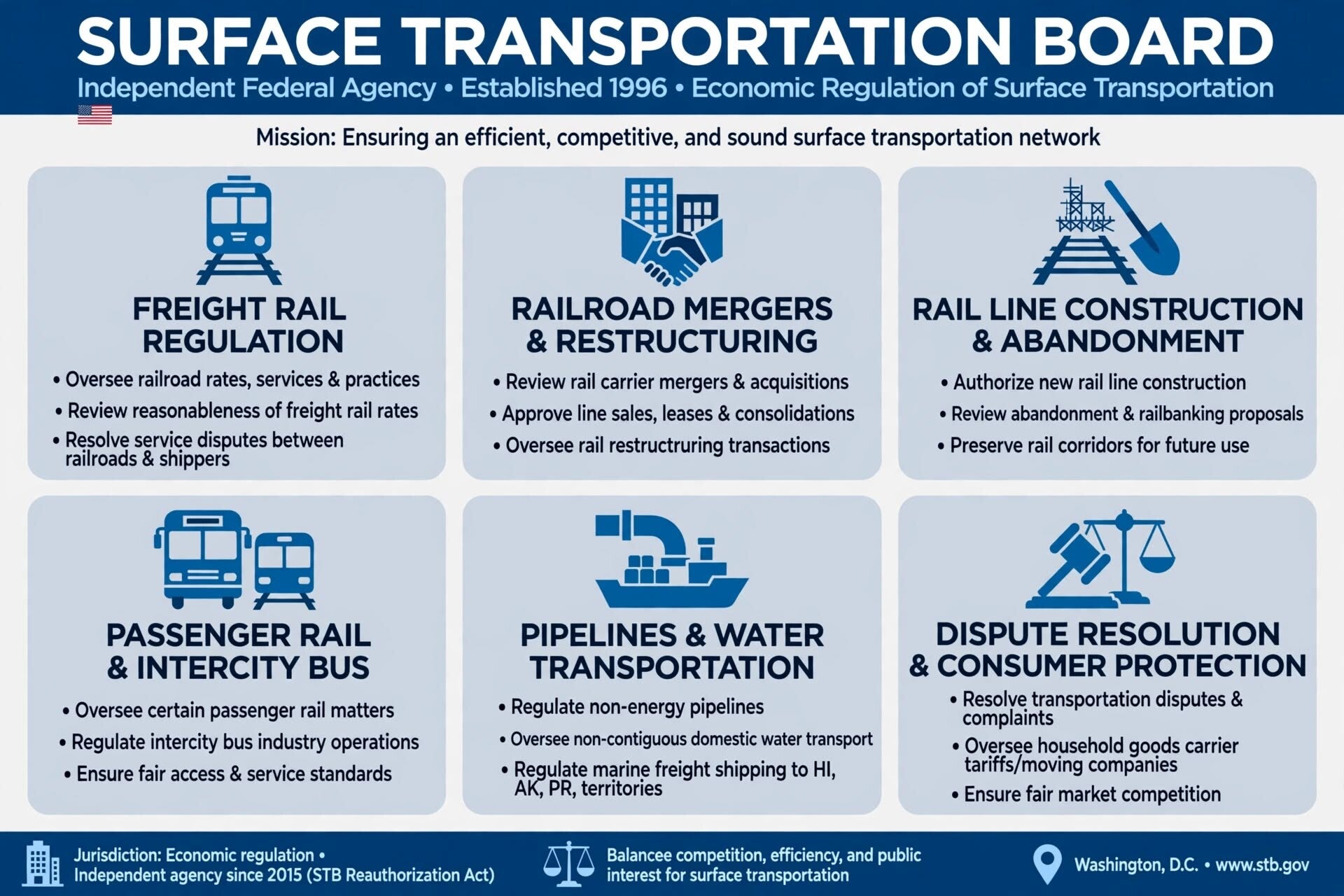
Functions of the Surface Transportation Board.
(© 2026 Trains and Railroads, All Rights Reserved)
SURFACE TRANSPORTATION BOARD
The Surface Transportation Board, or STB, is the federal agency that regulates much of America's freight rail system, along with certain interstate trucking, bus, and pipeline matters. It was created in 1996 as the successor to the Interstate Commerce Commission, or ICC, which had overseen railroads and other carriers since 1887. When Congress passed the ICC Termination Act of 1995, it abolished the ICC but kept a smaller, more focused regulator to handle the remaining economic oversight that a fully deregulated market still needed. The STB began operating on January 1, 1996, as an independent agency within the Department of Transportation, though it later became fully independent from the Department in 2015 under the Surface Transportation Board Reauthorization Act.
Its roots go back to the late 19th century, when the ICC was created to curb discriminatory pricing and monopolistic practices by railroads, which were then the dominant form of long-distance transportation. For nearly a century, the ICC exercised broad control over rates, routes, mergers, and market entry for railroads, trucking companies, and other carriers. That regulatory model began to loosen in the 1970s and 1980s, particularly with the Staggers Rail Act of 1980, which gave railroads far more freedom to set rates, abandon unprofitable lines, and negotiate contracts with shippers. The ICC Termination Act completed that shift, shrinking the federal role to a core set of competition and service issues rather than day-to-day rate regulation.
Today the STB's primary function is economic regulation of the freight rail industry. It reviews proposed railroad mergers and acquisitions, decides whether a railroad can abandon or discontinue service on a line, and resolves disputes between railroads and their customers. It also has authority over railroad rates, but only in specific circumstances: when a shipper is "captive" to a single railroad with no effective competitive alternative, and when the rate exceeds a threshold established by law. In those cases, the Board can determine whether the rate is reasonable and order reparations if it is not.
Beyond rate cases, the Board oversees a range of service and access issues that keep the rail network functioning. It adjudicates disputes over trackage rights, joint use of facilities, and reciprocal switching, which allows a shipper served by one railroad to access another railroad's network under certain conditions. It also reviews rail service complaints, such as allegations of inadequate service, unreasonable practices, or discrimination. In recent years, this service oversight has become more prominent as shippers have raised concerns about congestion, delays, and the effects of precision scheduled railroading on reliability.
The STB also retains more limited jurisdiction over other modes. It handles certain disputes involving interstate motor carriers and water carriers, and it licenses some pipeline carriers. In the passenger realm, it has authority over intercity bus service and, in certain cases, Amtrak's access to freight railroad tracks. While its docket is dominated by freight rail, this residual authority reflects its ICC heritage as a multi-modal surface transportation regulator.
The Board is led by five members appointed by the President and confirmed by the Senate, serving staggered five-year terms, with no more than three from the same political party. It operates through a formal adjudicative process, holding hearings, accepting evidence, and issuing decisions that can be appealed to federal courts. Its work balances two sometimes competing goals set by Congress: promoting a financially healthy and efficient rail system that can invest in its infrastructure, while protecting shippers and the public from abuses of market power where competition is absent.
Board Overview
Formed: January 1, 1996
Preceding board: Interstate Commerce Commission
Jurisdiction: United States
Headquarters: Washington, D.C.
Board executive: Patrick Fuchs, Chairman
Parent department: Independent agency
Key document: Interstate Commerce Commission Termination Act
Website: www.stb.gov