
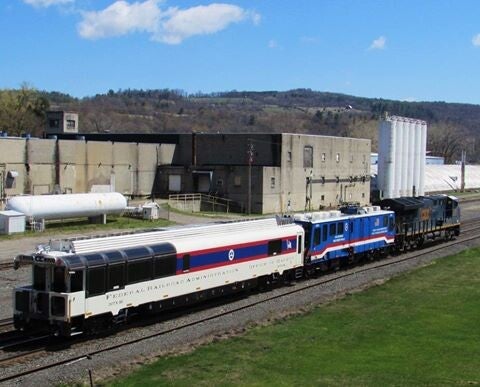
FRA Inspection Train in St. Johnsville, New York.
(John Koslosky, CC BY-SA 4.0 <https://creativecommons.org/licenses/by-sa/4.0>, via Wikimedia Commons)
FEDERAL RAILROAD ADMINISTRATION
The Federal Railroad Administration (FRA) was created by the Department of Transportation Act of 1966 as one of the operating administrations within the newly formed U.S. Department of Transportation. Its creation reflected a shift in federal policy: railroads, once regulated piecemeal by the Interstate Commerce Commission and state bodies, needed a dedicated federal agency focused specifically on safety, research, and national transportation policy. Congress gave the FRA a broad mandate to promote “fast, safe, efficient and convenient transportation at the lowest cost consistent therewith and with other national objectives,” language that still shapes its mission today.
In its early years, the FRA focused primarily on issuing and enforcing safety regulations for the nation’s rail system. That work included setting standards for track, equipment, operating practices, and personnel qualifications, and inspecting railroads to ensure compliance. It also took on responsibility for investigating railroad accidents, collecting safety data, and conducting research and development aimed at reducing collisions, derailments, and workplace injuries. The agency’s early authority was consolidated and expanded by the Federal Railroad Safety Act of 1970, which gave it clearer power to preempt state rules and to enforce federal standards uniformly across the country.
Over the following decades, the FRA’s role grew beyond pure safety enforcement to include financial assistance and infrastructure development. It became the conduit through which federal support for passenger and freight rail was provided, administering loan and grant programs, supporting Amtrak, and later funding high-speed and intercity passenger rail projects. After the creation of the Surface Transportation Board in 1996, economic regulation such as rates and mergers moved elsewhere, leaving the FRA to concentrate on safety and on promoting rail as a component of national transportation policy.
Today, the FRA’s stated mission is to enable the safe, reliable, and efficient movement of people and goods for a strong America. It oversees more than 140,000 miles of track and thousands of railroads, from major Class I freight carriers to short lines and commuter systems. Its inspectors conduct thousands of inspections each year on track, signals, motive power and equipment, hazardous materials, and operating practices, and it can issue civil penalties, emergency orders, and compliance directives when violations pose an immediate risk.
A second major function is research, testing, and standards development. The FRA operates research facilities, funds university research centers, and partners with industry on technologies such as positive train control, crashworthy passenger equipment, grade-crossing safety, and inspection automation. It also collects and analyzes accident and incident data to identify trends and target rulemaking, and it sets training and certification requirements for engineers, conductors, dispatchers, and other safety-critical workers. This research role connects directly to its rulemaking, allowing regulations to evolve with changes in technology and operating conditions.
Finally, the FRA plays a central role in shaping the future of U.S. rail through planning, grants, and loan programs. It administers programs for intercity passenger rail, rail infrastructure and safety improvements, grade-crossing elimination, and the Railroad Rehabilitation and Improvement Financing loan program. In recent years its budget has grown to support major capital projects, reflecting renewed federal interest in rail as a lower-emission, high-capacity alternative for both freight and passengers. In that sense, the agency now balances its original safety mandate with a broader economic and strategic function: keeping the existing network safe while helping expand and modernize it for the next generation.
Agency overview
Formed: April 1, 1967
Jurisdiction: United States
Headquarters: Washington, DC
Employees: 850
Annual budget: $1.561 billion (2008)
Agency executives:
David Fink, Administrator
Drew Feely, Deputy Administrator
Parent agency: U.S. Department of Transportation
Website: railroads.dot.gov