

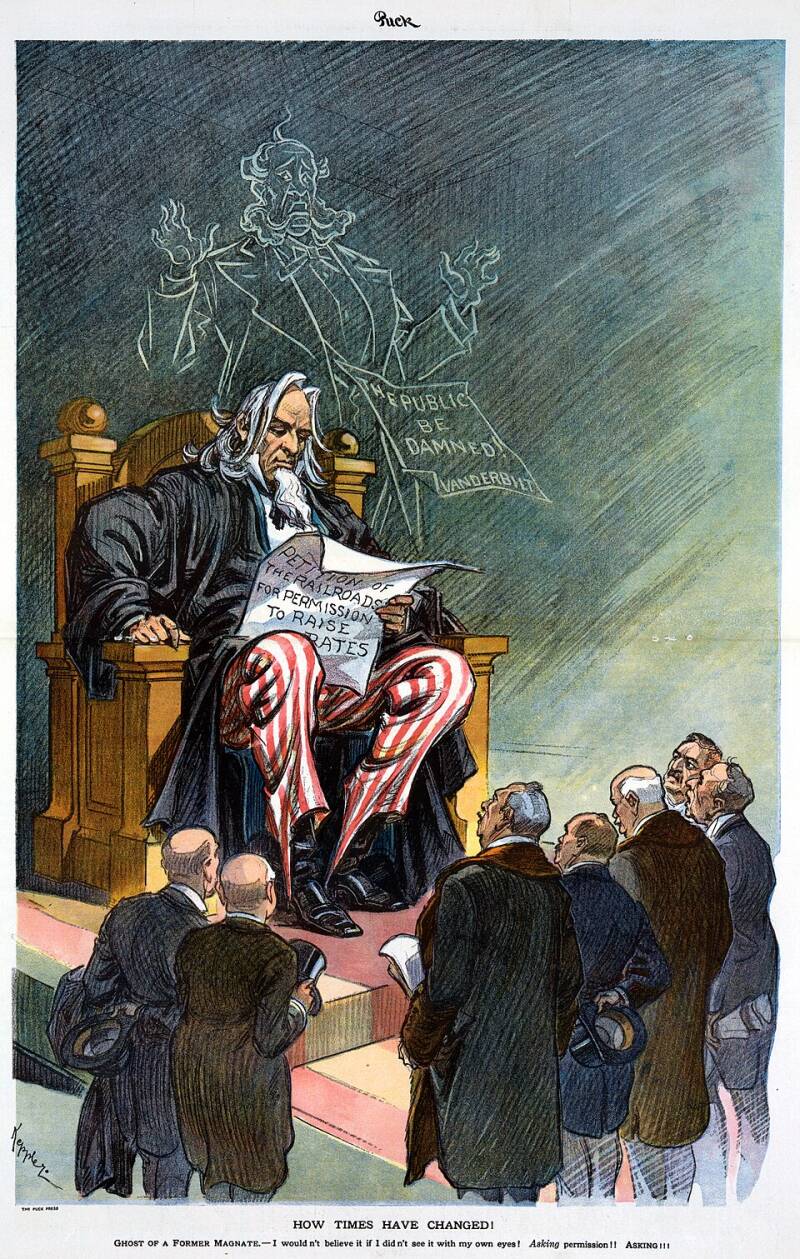
A 1914 cartoon shows railroad companies asking the ICC (depicted as Uncle Sam) for permission to raise rates,
while the ghost of a horrified William Henry Vanderbilt looks on.
(Udo Keppler, Public domain, via Wikimedia Commons)
INTERSTATE COMMERCE COMMISSION
The Interstate Commerce Commission, created by the Interstate Commerce Act of 1887, was the first federal regulatory agency in the United States. It was born out of decades of farmer and small-business anger at railroad monopolies. In the decades after the Civil War, railroads were the backbone of American commerce, but they charged wildly different rates depending on where you lived, gave secret rebates to large shippers like Standard Oil, and discriminated against short-haul and rural traffic. States tried to regulate them, but the Supreme Court ruled in Wabash, St. Louis & Pacific Railway Co. v. Illinois (1886) that only the federal government could regulate interstate commerce. Congress responded the next year by creating the ICC.
In its early years, the ICC was weak by design. It had five commissioners, the power to investigate complaints, and the authority to require railroads to charge “just and reasonable” rates, publish their tariffs, and stop long-haul versus short-haul discrimination. But it had no real enforcement power. Railroads routinely ignored its orders and tied it up in court, and the courts often sided with the railroads. For its first 15 years, the ICC functioned more as a fact-finding body and public forum for grievances than as a regulator with teeth.
That changed in the Progressive Era. The Hepburn Act of 1906 gave the ICC the power to set maximum railroad rates, expanded its jurisdiction to pipelines, bridges, and terminals, and made its orders binding unless overturned by a court. The Mann-Elkins Act of 1910 went further, extending ICC authority over telephone and telegraph companies and allowing it to suspend proposed rate increases. The Transportation Act of 1920, passed after the government returned the railroads from wartime control, authorized the ICC to set minimum as well as maximum rates to ensure railroads earned a “fair return,” effectively making it a manager of railroad solvency as well as a policeman of unfair practices.
The Commission’s mandate expanded well beyond railroads in the 1930s. The Motor Carrier Act of 1935 brought interstate trucking under its jurisdiction, requiring truckers to get certificates of public convenience and necessity and file rates. The Transportation Act of 1940 consolidated federal transportation policy, added domestic water carriers, and declared a national policy of promoting safe, adequate, economical, and efficient service across modes. By mid-century, the ICC was regulating a huge swath of American freight and passenger movement, determining who could enter a market, what they could charge, and what routes they could serve.
The ICC also played a quieter but important role in civil rights. Because its jurisdiction covered interstate passenger travel, its rulings on segregation became national landmarks. In 1955, after the Supreme Court’s decision in Brown v. Board of Education, the ICC banned segregation in interstate bus terminals, waiting rooms, and restaurants serving interstate travelers. The 1961 Freedom Rides forced the issue into the headlines, and the ICC issued stronger orders in 1961 requiring carriers to display signs that seating was without regard to race and to stop segregated service in practice, not just on paper.
By the 1970s and 1980s, the very success of regulation had made the ICC a target. Economists and shippers argued that rate controls and entry barriers protected inefficient incumbents, raised prices, and stifled innovation, especially compared to unregulated trucking and airlines. Deregulation came in waves: the Railroad Revitalization and Regulatory Reform Act of 1976, the Motor Carrier Act of 1980, and the Staggers Rail Act of 1980 stripped away most rate and entry controls. The ICC’s remaining functions were transferred to the Surface Transportation Board, and the Commission was formally abolished in 1995, closing a 108-year experiment in federal economic regulation.
Agency overview
Formed: February 4, 1887
Dissolved: January 1, 1996
Superseding agency: Surface Transportation Board
Jurisdiction: United States
Key documents: Interstate Commerce Act of 1887, Interstate Commerce Commission Termination Act