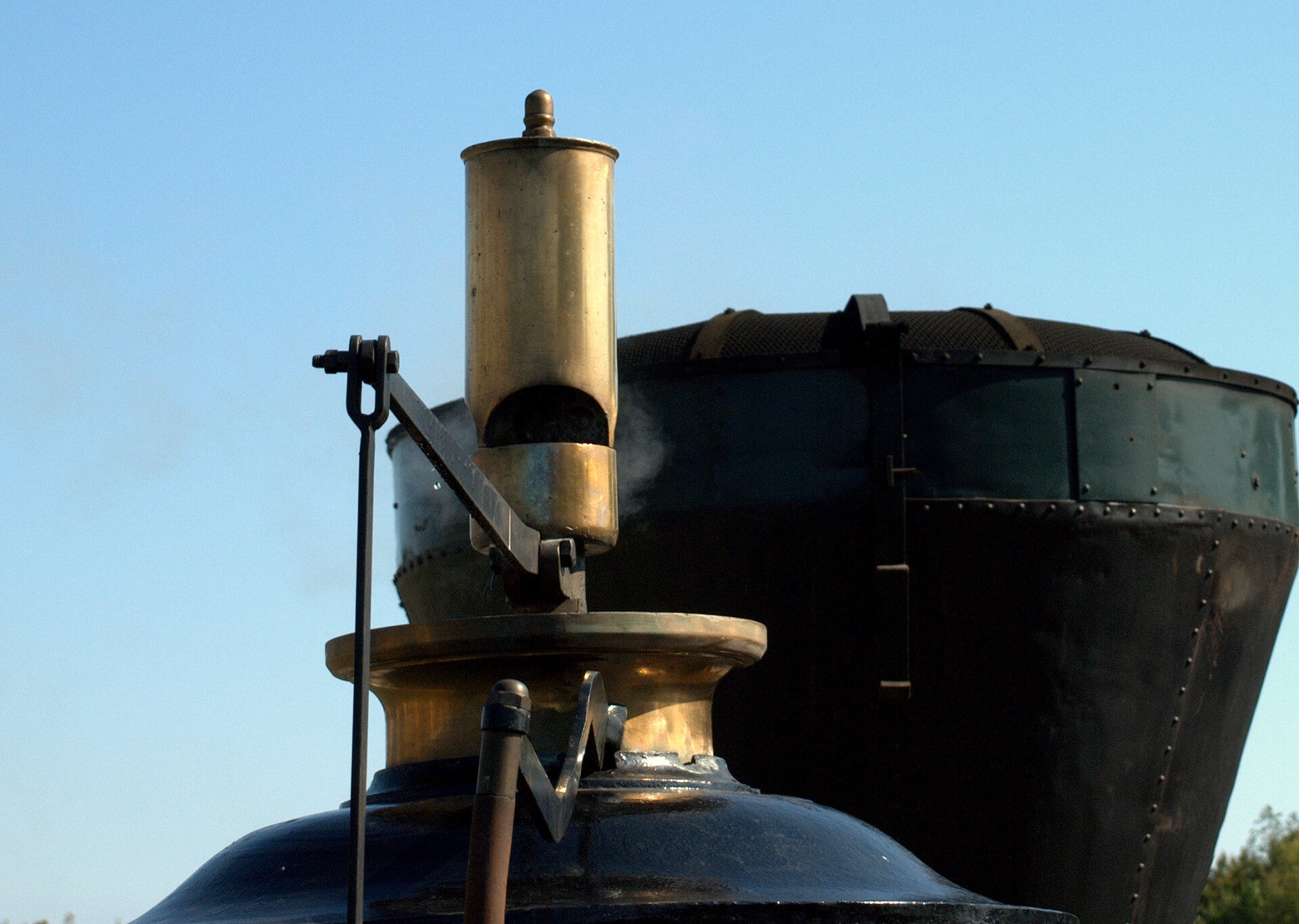
Train whistle on a 1950 0-4-0 tank engine built by the H.K Porter Company, at the B&O Railroad Museum.
(kevygee, CC BY-SA 2.0 <https://creativecommons.org/licenses/by-sa/2.0>, via Wikimedia Commons)
STEAM TRAIN WHISTLES
A steam whistle is a device used to produce sound in the form of a whistle using pressurized steam, which creates, projects, and amplifies its sound by acting as a vibrating system.
Operation
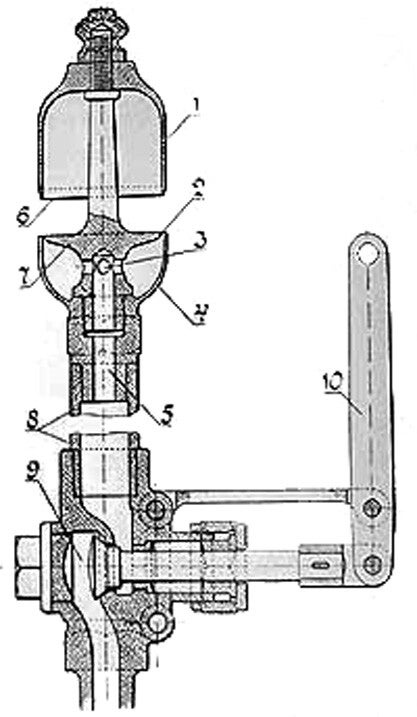
The whistle consists of the following main parts, as seen on the drawing: the whistle bell (1), the steam orifice or aperture (2), and the valve.
When the lever (10) is actuated (usually via a pull cord), the valve opens and lets the steam escape through the orifice. The steam will alternately compress and rarefy in the bell, creating the sound. The pitch, or tone, is dependent on the length of the bell and how far the operator has opened the valve. Some locomotive engineers invented their own distinctive style of whistling.
Uses of steam whistles
Steam whistles are often used on buildings such as factories, universities, and similar places to signal the start or end of a work shift, etc. Steam railway locomotives, traction engines, and steam ships have traditionally been fitted with a steam whistle for warning and communication purposes. Large diameter, low-pitched steam whistles were used on light houses, likely beginning in the 1850s.
The earliest use of steam whistles was as boiler low-water alarms in the 18th century and early 19th century. During the 1830s, whistles were adopted by railroads and steamship companies.
Raiload use of whistles
Steam warning devices have been used on trains since 1833, when George Stephenson invented and patented a steam trumpet for use on the Leicester and Swannington Railway. Period literature makes a distinction between a steam trumpet and a steam whistle. A copy of the trumpet drawing signed May 1833 shows a device about eighteen inches high with an ever-widening trumpet shape with a six-inch diameter at its top or mouth. It is said that George Stephenson invented his trumpet after an accident on the Leicester and Swannington Railway where a train hit either a cart, or a herd of cows, on a level crossing and there were calls for a better way of giving a warning. Although no-one was injured, the accident was deemed serious enough to warrant Stephenson's personal intervention. One account states that engineer Weatherburn had 'mouthblown his horn' at the crossing in an attempt to prevent the accident, but that no attention had been paid to this audible warning, perhaps because it had not been heard.
Stephenson subsequently called a meeting of directors and accepted the suggestion of the company manager, Ashlin Bagster, that a horn or whistle which could be activated by steam should be constructed and fixed to the locomotives. Stephenson later visited a musical instrument maker on Duke Street in Leicester, who on Stephenson's instructions constructed a 'Steam Trumpet' which was tried out in the presence of the board of Directors ten days later.
Stephenson mounted the trumpet on the top of the boiler's steam dome, which delivers dry steam to the cylinders. The company went on to mount the device on its other locomotives
Locomotive steam trumpets were soon replaced by steam whistles. Air whistles were used on some diesel and electric locomotives, but these mostly employ air horns.
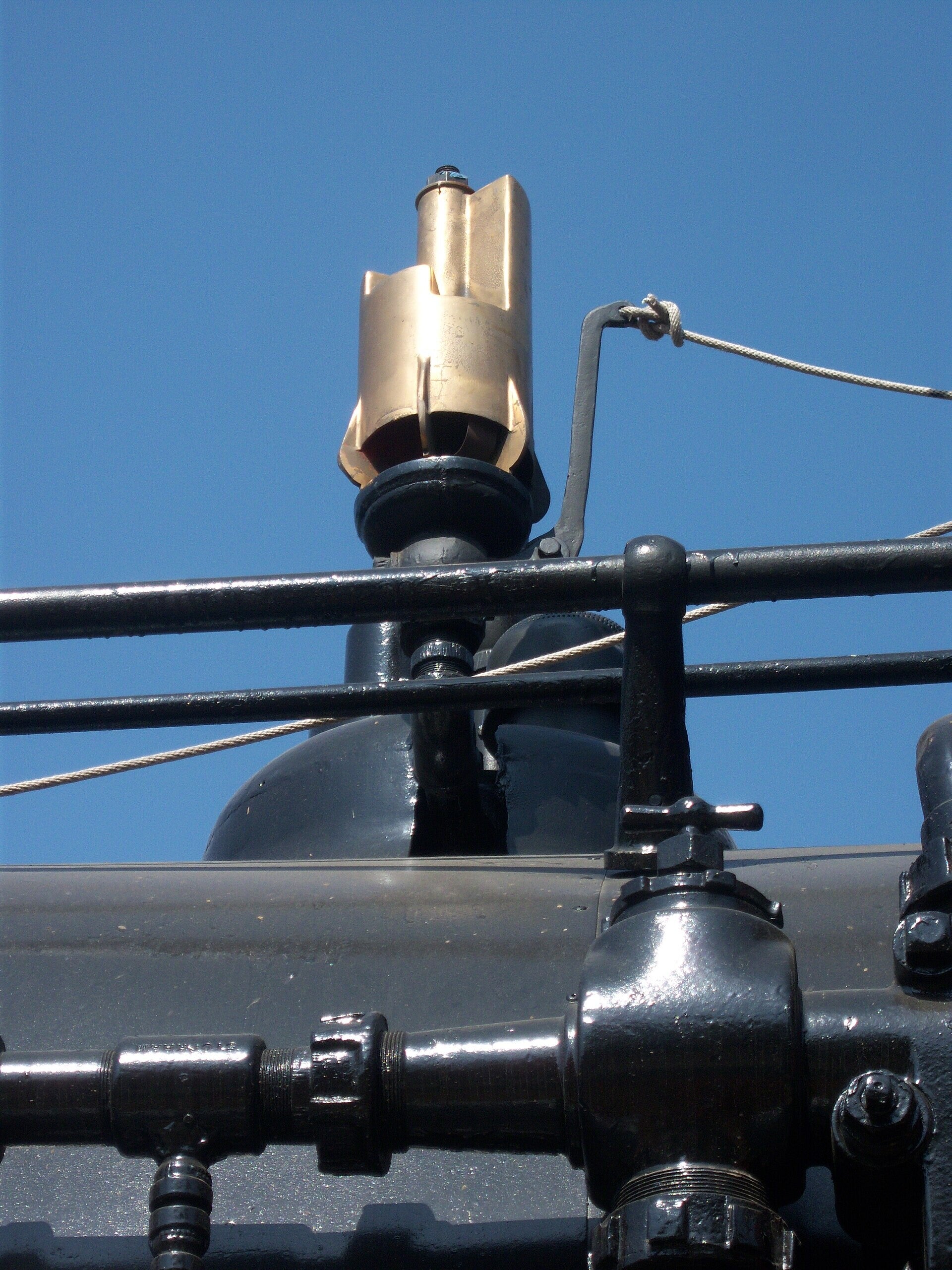
A whistle atop Mogul Engine 1629, a class M4 engine weighing 75 tons, with a 2-6-0 wheel arrangement. It was built in Schenectady, New York, in 1900, and purchased by Southern Pacific Railroad for use on the line which ran from Yuma, Arizona to Portland, Oregon, passing through the Santa Clarita Valley. In 1957, it was retired and sold to Western actor, Gene Autry, who used it in films at his Melody Ranch in Placerita Canyon. It appeared in such television series as "Gunsmoke" and "Wyatt Earp." Autry donated the locomotive in 1981 to the Santa Clarita Valley Historical Society, and it was moved to its present location next to the Saugus Station using donated funds in 1982, where it is being restored as a static display.
(Konrad Summers, CC BY-SA 2.0 <https://creativecommons.org/licenses/by-sa/2.0>, via Wikimedia Commons)
Train Whistles
A train whistle or air whistle (originally referred to as a train trumpet or air trumpet) is an audible signaling device on a railway locomotive, used to warn that the train is approaching, and to communicate with rail workers. Steam whistles were commonly used on steam locomotives, and were replaced with air horns on diesel and electric locomotives. However, the word whistle continues to be used by railroaders in referring to such signaling practices as "whistling off" (sounding the horn when a train gets underway).
The need for a whistle on a locomotive exists because trains move on fixed rails and thus are uniquely susceptible to collision. This susceptibility is exacerbated by a train's enormous weight and inertia, which make it difficult to quickly stop when encountering an obstacle. Hence a means of warning others of the approach of a train from a distance is necessary. As train whistles are inexpensive compared to other warning devices, the use of loud and distinct whistles became the preferred solution for railway operators.
Steam whistles were almost always actuated with a pull cord (or sometimes a lever) that permitted proportional (tracker) action, so that some form of "expression" could be put into the sound. Many locomotive operators would have their own style of blowing the whistle, known as "quilling", and it was often apparent who was operating the locomotive by the sound. Modern locomotives often make use of a push button switch to operate the air horn, eliminating any possibility of altering the horn's volume or pitch.
North American usage
North American steam locomotive whistles have different sounds from one another. They come in many forms, from tiny little single-note shriekers to larger plain whistles with deeper tones (a deep, plain train whistle is the "hooter" of the Norfolk & Western, used on their A- and Y-class Mallet locomotives). Even more well known were the multi-chime train whistles. Nathan of New York copied and improved Casey Jones's boiler-tube chime whistle by casting the six chambers into a single bell, with open "steps" on top to save on casting.
Another very popular American train whistle was, again, a Nathan product. This was a five-note whistle, with a much shorter bell, and therefore, much higher in pitch. This whistle produced a bright G-major 6th chord (GBDEG) and, again, was heavily imitated, copies being made by many different railroads.
The most popular American chime train whistle was the three-note version. These were either commercially made (Crosby, Lunkenheimer, Star Brass, Hancock Inspirator Co. among others) or shop-made by the railroads themselves. Some famous and very melodious shop-made train whistles were the Pennsylvania Railroad's passenger chimes and the Baltimore and Ohio Railroad's step-top three chimes, as well as the Reading Company's six-chime whistle used on passenger locomotives. But the most beloved of all three-chime train whistles to the public and railroaders alike were the deep-chorded "steamboat minor" long-bells. A well known commercially made chime was Hancock Inspirator Company's three-note step top. These found use on almost every American railroad. Some railroads copied these also, examples being found on the old St. Louis–San Francisco Railway, Southern Railway and the Illinois Central Railroad.
Whistle code
Train whistles are used to communicate with other railroad workers on a train or in the yard. Specific combinations of long and short whistles have specific meanings. They are used to pass instructions, as a safety signal, and to warn of impending movements of a train. Despite the advent of modern radio communication, many of these whistle signals are still used today. (See also Train horn § Common horn signals.)
Signals below are American practice: ▄ represents short sounds, and ▄▄▄ for longer ones.
| Sequence | Meaning |
|---|---|
| ▄ ▄ | Acknowledgment of any signal not otherwise provided for |
| ▄ ▄ ▄ | When train is stopped: backing up, or acknowledgment of a hand signal to back up; when moving: stop at next station |
| ▄ ▄ ▄ ▄ | Request for a signal to be given, or repeated if not understood |
| ▄▄▄ | When train is stopped: air brakes are applied and pressure is equalized |
| ▄▄▄ ▄▄▄ | Train releases brakes and proceeds |
| ▄▄▄ ▄▄▄ ▄▄▄ ▄▄▄ | Flagman return from the west or south |
| ▄▄▄ ▄▄▄ ▄▄▄ ▄▄▄ ▄▄▄ | Flagman return from the east or north |
| ▄▄▄ ▄ | Inspect the brake system for leaks or sticking brakes |
| ▄▄▄ ▄ ▄ | Warning that a second section of a timetabled train is following |
| ▄▄▄ ▄ ▄ ▄ | Instruction for flagman to protect rear of train |
| ▄▄▄ ▄▄▄ ▄ ▄▄▄▄ | Train is approaching public grade crossing(s), known as Rule 14L in almost all railroad operating rules; also used in Australia |
| Series of short blasts | An emergency exists, or if persons or livestock are on the track |
Not all railroads use exactly the same whistle signals or assign the same meanings. Some railroads will use their own variations of the above. A few of the signals are obsolete because the workers they were used to communicate with (such as flagman) are now obsolete.
Vintage Train Sounds
Click on the above image to hear more Vintage Train Sounds on YouTube.