
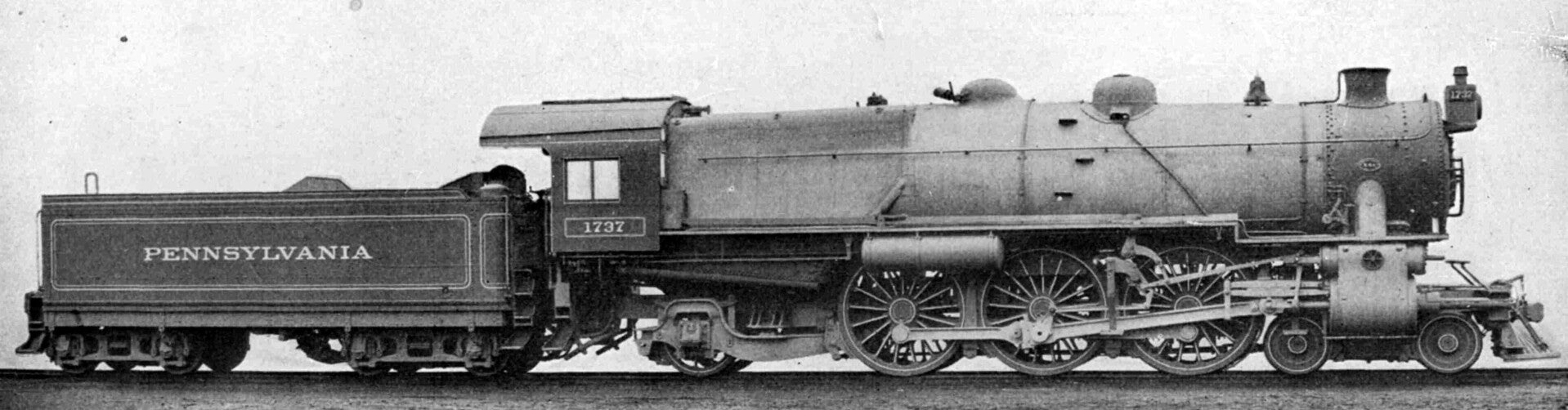
PRR No. 1737 builder's photo in May 1914.
(This work is in the public domain in the United States because it was published (or registered with the U.S. Copyright Office) before January 1, 1931.)


PENNSYLVANIA RAILROAD 1737
Pennsylvania Railroad 1737 was a 4-6-2 Pacific type K4 class steam locomotive built in 1914 as the first of its class and would haul heavier passenger trains that the smaller E class 4-4-2 Atlantics could not handle such as the PRR's flagship passenger train, the Broadway Limited. In the 1930s, as the PRR had increased passenger service time tables, the trains became longer and heavier than a single K4s could handle, necessitating double-heading with a second engine. The "Standard Railroad Of The World" made attempts to replace the 1737 and its classmates with larger, more powerful classes including: K5, S1, and the T1, none of which were successful; thus, the K4s continued hauling passenger trains until the Pennsylvania Railroad replaced steam locomotives with the increasingly-popular and less-costly diesel-electric locomotives in 1957.
History
Origin and trials
No. 1737 was the prototype of K4 class 4-6-2 steam locomotive built in May 1914 at Juniata Shop for the Pennsylvania Railroad (PRR).
Revenue service
The 1737 was no stranger to commuter service. The New York and Long Branch Railroad in South Amboy, New Jersey used the K4s to haul commuter trains. When the famous electric Pennsylvania Railroad class GG1 would bring the trains from New York City's Penn Station, the K4s would take over the train and make the run from the South Amboy station to Bay Head, New Jersey.
Fate
In May 1956, No. 1737 was chosen to be preserved as part of the PRR's Historical Collection at a roundhouse in Northumberland, Pennsylvania. However, the locomotive was left outside in Altoona, exposed to the elements to the point where it was completely deteriorated in very poor condition to be preserved. Instead, the PRR quietly took another K-4, No. 3750, and renumbered it to represent No. 1737 while the real No. 1737 was broken up for scrap in February 1960. No. 1737's original 110-P-75 tender is now coupled to No. 3750.
Overview
Type and origin
Power type: Steam
Designer: J.T. Wallis, Alfred W. Gibbs, and Axel Vogt
Builder: Altoona Works
Serial number: 2825
Build date: May 1914
Specifications
Configuration:
• Whyte: 4-6-2
Gauge: 4 ft 8+1⁄2 in (1,435 mm)
Leading diameter: 36 in (914 mm)
Driver diameter: 80 in (2,032 mm)
Trailing diameter: 50 in (1,270 mm)
Wheelbase: 13 ft 10 in (4.2 m) between driving axles
Length: 83 ft 6 in (25.5 m)
Axle load: 66,500 lb (30,200 kg; 30.2 t)
Adhesive weight: 199,500 lb (90,500 kg; 90.5 t)
Locomotive weight: 304,500 lb (138,100 kg; 138.1 t)
Tender weight: 212,725 lb (96,490 kg; 96.490 t)
Total weight: 517,225 lb (234,609 kg; 234.609 t)
Fuel type: Coal
Fuel capacity: 22 tons (20 t)
Water capacity 11,300 US gallons (43,000 L)
Firebox:
• Grate area: 69.89 sq ft (6.49 m2)
Boiler pressure: 205 psi (1,413 kPa)
Heating surface: 4,041 square feet (375 m2)
Cylinders: Two, outside
Cylinder size: 27 in × 28 in (686 mm × 711 mm)
Valve gear: Walschaert
Valve type: Piston valves
Performance figures
Tractive effort: 44,460 lbf (197,770 N)
Factor of adhesion: 4.54
Career
Operators: Pennsylvania Railroad
Class: K4s
Number: PRR 1737
Delivered: 1914
First run: 1914
Retired: 1956
Disposition: Scrapped
