
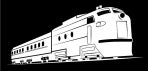

Locomotive 653, shown here at the Texas & Pacific Railroad Station in Marshall, Texas, circa 1946, has a feedwater heater.
(Robert Yarnall Ritchie, No restrictions, via Wikimedia Commons)
FEEDWATER HEATER
Steam locomotive feedwater heaters were one of the most important efficiency improvements added to American locomotives in the 20th century. Their job was simple in concept, but it saved a lot of coal and water on long runs.
What they do
A steam locomotive burns coal to boil water and make steam. That steam pushes the pistons, then exhausts out the stack.
The problem is that the boiler has to constantly replace the water turned into steam, and cold water pumped straight into a hot boiler:
- Cools the boiler, forcing the fireman to burn more coal to keep pressure up
- Causes thermal shock to the boiler sheets and tubes
- Wastes a lot of the heat that already went up the stack
A feedwater heater recaptures waste heat from the exhaust steam and uses it to pre-heat the water before it enters the boiler.
Typically, water from the tender goes from about 60-70°F up to 200-250°F in the heater. That means the boiler doesn't have to do all that heating work, so you get roughly a 10-15% fuel savings and less boiler wear.
The two main types used in the U.S.
1. Open-type heaters (exhaust-steam heaters)
The most common on American roads were the Elesco and Worthington open-type heaters.
How they worked:
- Exhaust steam from the cylinders was piped into a chamber in the heater, where it mixed directly with the cold feedwater
- The mixture was pumped into the boiler by a feedwater pump
- Any surplus exhaust steam that wasn't condensed was vented
These were usually mounted on top of the smokebox, ahead of the stack. You can spot them as that big cylindrical tank on the front top of many late-era locomotives, like on Nickel Plate Berkshires, N&W Class J's, and many Pennsylvania Railroad and New York Central engines.
2. Closed-type heaters
The Coffin feedwater heater was the main closed type.
How it worked:
- Exhaust steam passed through tubes inside a closed tank, but never mixed with the feedwater
- The feedwater flowed around those tubes and picked up the heat by conduction
- A separate injector then forced the hot water into the boiler
Closed heaters were less efficient than open heaters, but they were simpler and avoided mixing oil-contaminated exhaust steam with boiler water. They were common on Southern Pacific and some Union Pacific locomotives.
Why railroads loved them, and why they were a headache
Benefits:
- Less coal burned for the same work, critical for long, water-scarce western runs and fast passenger service
- Less cold-water shock, which extended boiler life and reduced maintenance
- Slightly increased boiler capacity, since less of the firebox heat was wasted warming cold water
Drawbacks:
- Extra complexity, pumps, piping, and valves to maintain
- Open heaters could carry cylinder oil into the boiler, causing foaming and priming if not carefully maintained
- They added weight on the front end and made the locomotive look more cluttered, which is why some roads skipped them on smaller switchers and branch-line engines where the fuel savings didn't pay for the upkeep
By the 1930s-1940s, feedwater heaters were standard equipment on virtually all new mainline passenger and heavy freight locomotives in America. Smaller locomotives, yard switchers, and short-line engines often stayed with plain injectors because they ran short trips and didn't use enough water to justify the cost.
In short, they were a waste-heat recovery system — take heat that would have been thrown away up the stack and put it back into the water before it ever reaches the boiler.
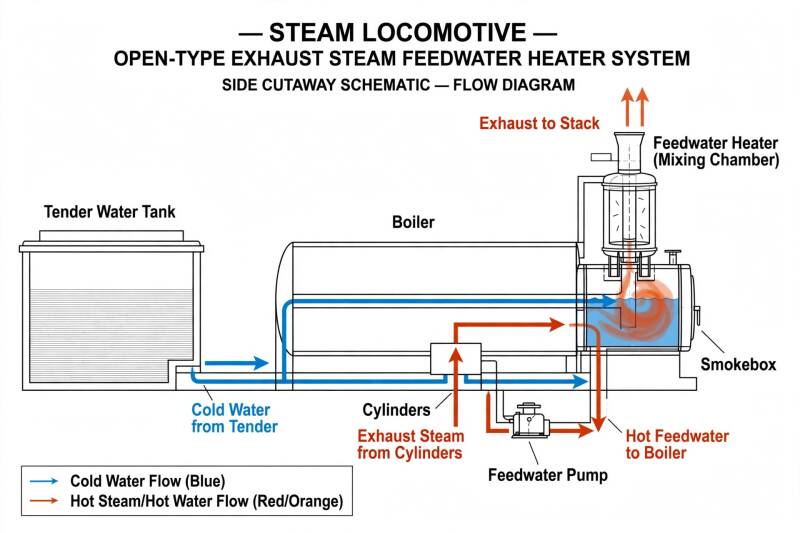
This is the open-type system — the Elesco / Worthington arrangement used on most American mainline power.
Follow the colors:
Blue = cold water
- Cold Water from Tender leaves the tender tank and runs forward along the boiler to the heater.
Red/Orange = hot steam and hot water
- Exhaust Steam from Cylinders comes up from the cylinders after it has done its work pushing the pistons.
- Inside the Feedwater Heater (Mixing Chamber) on top of the smokebox, that exhaust steam mixes directly with the cold water. The steam condenses, giving up its heat, and warms the water to around 200-250°F.
- The Feedwater Pump then forces that Hot Feedwater to Boiler under pressure into the boiler.
- Any steam that doesn't condense vents out as Exhaust to Stack, helping draft the fire.
The key is that mixing chamber — it's not just a tank on top. It's where waste heat is recovered instead of being thrown away.
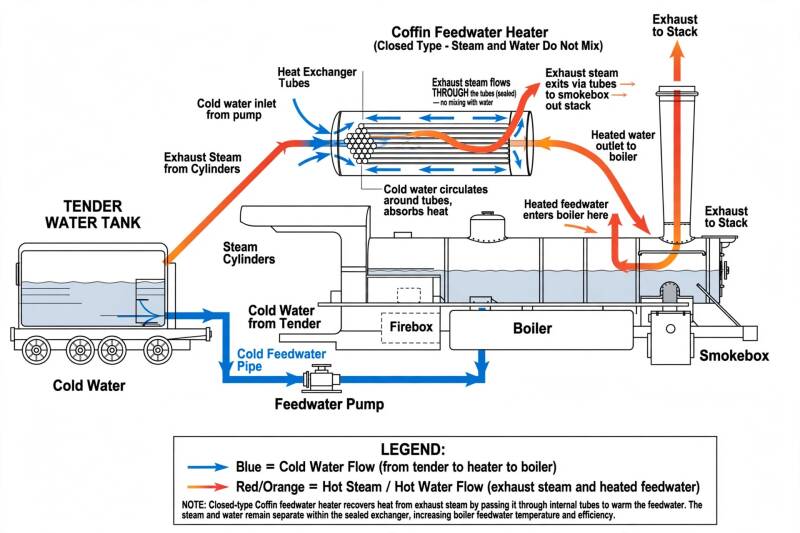
This is the Coffin — the opposite philosophy from the open heater shown above.
The difference is right in the middle:
In the Elesco/Worthington, exhaust steam and cold water mix together in one chamber.
In the Coffin, they never touch:
- Blue = Cold Water from Tender — the feedwater pump pushes cold water from the tender into the outside of the heater shell.
- Red = Exhaust Steam from Cylinders — that steam runs inside the sealed Heat Exchanger Tubes.
- The cold water circulates around those tubes, picks up heat through the tube walls, and leaves as hot water.
- That Heated water outlet to boiler then goes back down into the boiler under pressure.
- The spent exhaust steam, now cooled and condensed, exits via the tubes to the Smokebox and out the Exhaust to Stack.
Why railroads chose the Coffin:
- No oil in the boiler. Open heaters could carry cylinder oil straight into the boiler water, causing foaming and priming. The Coffin keeps the oily exhaust steam sealed away.
- Cleaner, simpler water treatment.
The trade-off:
It was less thermally efficient than the open type, because you only get heat transfer through the metal, not direct mixing. It also needed more tube surface area, which is why Coffin heaters tend to be that long, horizontal cylinder you see on top of Southern Pacific and some Union Pacific power.