
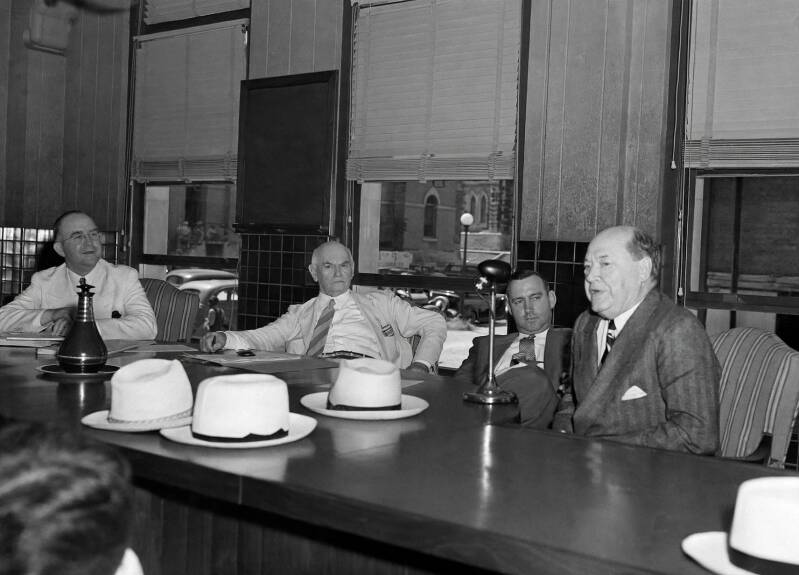
Members of the Texas Railroad Commission, which regulates the oil industry in the state, are shown during a hearing in Austin, Texas on Aug. 1, 1940. New York oil magnate Harry F. Sinclair, at microphone, testifies while Ernost Thompson, from left, Lon Smith and Commission Chairman Jerry Sadler listen. (AP Photo)

TEXAS RAILROAD COMMISSION
The Texas Railroad Commission (TRC), now known as The Railroad Commission of Texas (RRC), is the state agency that regulates the oil and gas industry, gas utilities, pipeline safety, safety in the liquefied petroleum gas industry, and surface coal and uranium mining. Despite its name, it ceased regulating railroads in 2005, when the last of the rail functions were transferred to the Texas Department of Transportation.
Established by the Texas Legislature in 1891, it is the state's oldest regulatory agency, and it began as part of the Efficiency Movement of the Progressive Era. From the 1930s to the 1960s, it largely set world oil prices, but was displaced by OPEC (Organization of Petroleum Exporting Countries) after 1973. In 1984, the federal government took over transportation regulation for railroads, trucking, and buses, but the Railroad Commission kept its name.
The three-member commission was initially appointed by the governor, but an amendment to the state's constitution in 1894 established the commissioners as elected officials who serve overlapping six-year terms, like the sequence in the U.S. Senate, elected statewide. No specific seat is designated as chairman; the commissioners choose the chairman from among themselves. Normally, the commissioner who faces reelection is the chairman for the preceding two years.
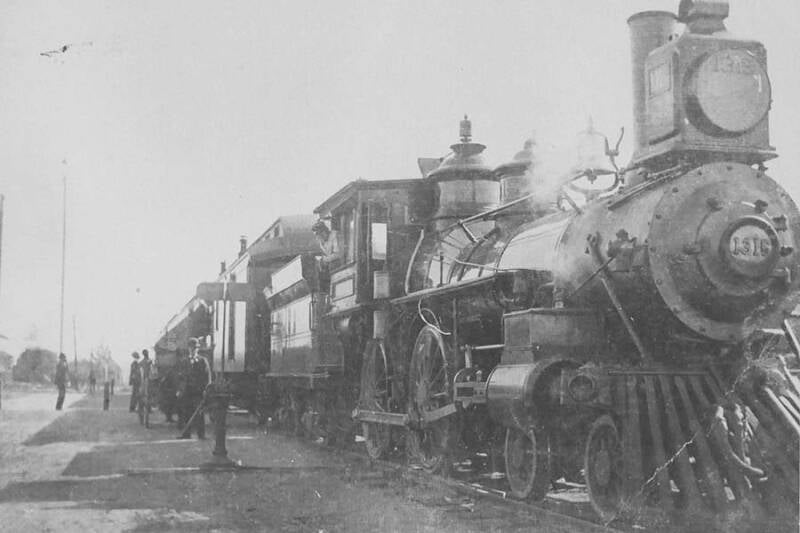
The Railroad Commission was originally tasked with regulating railroads such as the Houston and Texas Central Railway (H&TC), which was chartered in 1848 and eventually had lines stretching from Houston to Dallas, Denison, and Waco. (Photo courtesy of the TRC)
Origins
Attempts to establish a railroad commission in Texas began in 1876. After five legislative failures, an amendment to the state constitution that provided for a railroad commission was submitted to voters in 1890. The amendment's ratification and the 1890 election of Governor James S. Hogg, a Democrat, permitted the legislature in 1891 to pass legislation that constitutionally created the Railroad Commission of Texas, and gave it jurisdiction over the operations of railroads, terminals, wharves, and express companies. It could set rates, issue rules on how to classify freight, require adequate railroad reports, and prohibit and punish discrimination and extortion by corporations. George Clark, running as an independent “Jeffersonian Democratic” candidate for governor in 1892, denounced the TRC as being “Wrong in principle, undemocratic, and unrepublican.” Clark opined that the TRC and similar “Commissions do no good. They do harm. Their only function is to harass. I regard it as essentially foolish and essentially vicious.” Clark lost the 1892 election to Hogg, but federal judge Andrew Phelps McCormick granted an injunction preventing the TRC from enforcing compliance and seeking to prosecute or recover penalties from railroad companies the same year; the decision was overruled by the United States Supreme Court in 1894. The governor appointed the first members; the first elections to the commission were held in 1893, with three commissioners serving six-year, overlapping terms. The TRC did not have jurisdiction over interstate rates, but Texas was so large that the in-state traffic it regulated was of dominant importance.
The agency did not have the legal authority to set rates, nor did it have the resources to spend much of its time in court battles. The carrot was far more important than the stick. Freight rates continued to decline dramatically. In 1891, a typical rate was 1.403 cents per ton mile. By 1907, the rate was 1.039 cents—a decline of 25%. However, the railroads did not have rates high enough for them to upgrade their equipment and lower costs in the face of competition from pipelines along with cars and trucks, the infrastructure of which operated at a loss, and the Texas railway system began a slow decline
Segregation
From the 1890s through the 1960s, the Texas Railroad Commission found it difficult to fully enforce Jim Crow segregation legislation. Because of the expense involved, Texas railroads often allowed wealthier blacks to mix with whites, rather than provide separate cars, dining facilities, and even depots. In addition, West Texas authorities often refused to enforce Jim Crow laws because few African Americans resided there. In the 1940s, the railroad commission's enforcement of segregation laws began collapsing further, in part because of the great number of African American soldiers that were transported during World War II. The trains were integrated in the early 1960s.
Valuations
Texas was the first state to attempt to valuate its railroads. In 1893, 15,000 dollars were allotted to the appraisal process of Texas rail over the course of 2 years. By 1895 the appraised infrastructure was valued at $93,785,159 by the two civil engineers hired to undertake the task.
While originally handled by the Rail Road Commission of Texas, this task, like other rail related regulatory tasks, has been left in the hands of other agencies, county appraisal districts now handle property railroad property reporting.
Agency overview
Formed: 1891
Jurisdiction: Texas
Headquarters: Austin, Texas
Employees: 835
Agency executives:
Wayne Christian, Commissioner
Christi Craddick, Commissioner
Jim Wright, Chairman
Website: www.rrc.texas.gov
See Also: