
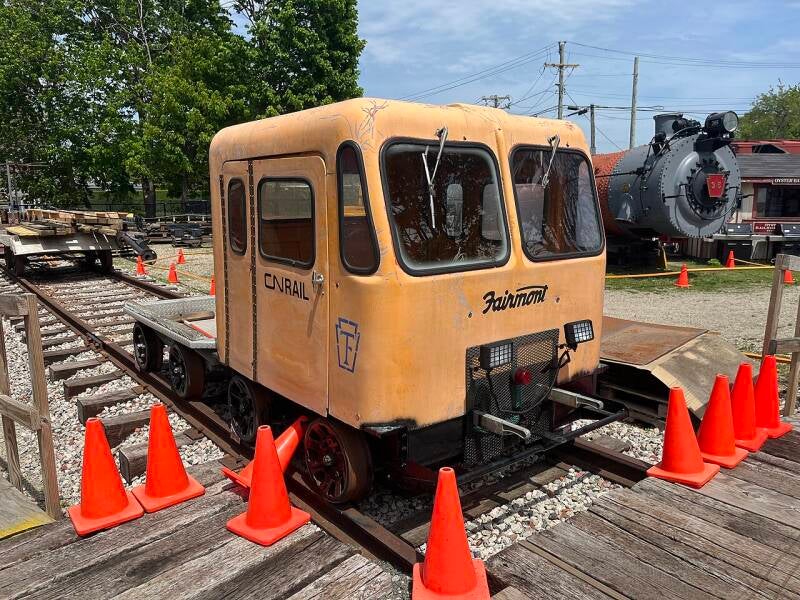
A CN Fairmont Speeder at Oyster Bay Railroad Museum.
(lostplanetcomics1, CC BY-SA 2.0, via Wikimedia Commons)

RAILROAD SPEEDER
A speeder (also known as a section car, railway motor car, putt-putt, track-maintenance car, crew car, jigger, trike, quad, personnel carrier, trolley, inspection car, or draisine) is a small railcar used around the world by track inspectors and work crews to move quickly to and from work sites. Although slow compared to a train or car, it is called speeder because it is faster than a human-powered vehicle such as a handcar. Motorized inspection cars date back to at least 1895, when the Kalamazoo Manufacturing Company started building gasoline engine powered inspection cars.
In the 1990s, many speeders were replaced by pickup trucks or sport utility vehicles with additional flanged wheels that could be lowered for travelling on rails, called "road–rail vehicles" or hi-rails for "highway-railroad". Speeders are collected by hobbyists, who refurbish them for excursions organized by the North American Railcar Operators Association in the U.S. and Canada and the Australian Society of Section Car Operators, Inc. in Australia.
Motorcar manufacturers and models
United States
- Beavercar (BMC-2m BMC-4m BMC-B)
- Buda
- Casey Jones (531)
- Fairbanks-Morse (40-B, 101, 757)
- Fairmont Railway Motors Inc
- S2, S2-A, S9, S9, S9-A, S9-B, S9-C S9-D
- 1100 2100 3100 4100 5100 6100
- A2-A8 Series
- M2 M9 M14 MT14 M15 M17 M19 MT19
- S2 ST2 C7 CD7 CK7 CR7
- Gibson Manufacturing Corporation
- Kalamazoo
- 23 Series B, 23 Series T, 27, 560N
- Portec
- Sheffield
- 40-B
Canada
- Sylvester Steel Products
- "21" section car with "120" engine (steel frame)
- "21E" section car with "KP" engine (aluminum frame)
- "K54" inspection car with "KP" engine (aluminum frame)
- Tamper
- TMC-2, TMC-6, TMC-8, TMC-12
- D Wickham & Co Ltd
- Wickham trolley
- Woodings
- CBI, CBL
- Railway Workshops
Various railways and their workshops also manufactured speeders. Often these were a copy of commercially available cars, such as Wickham and Fairmont.
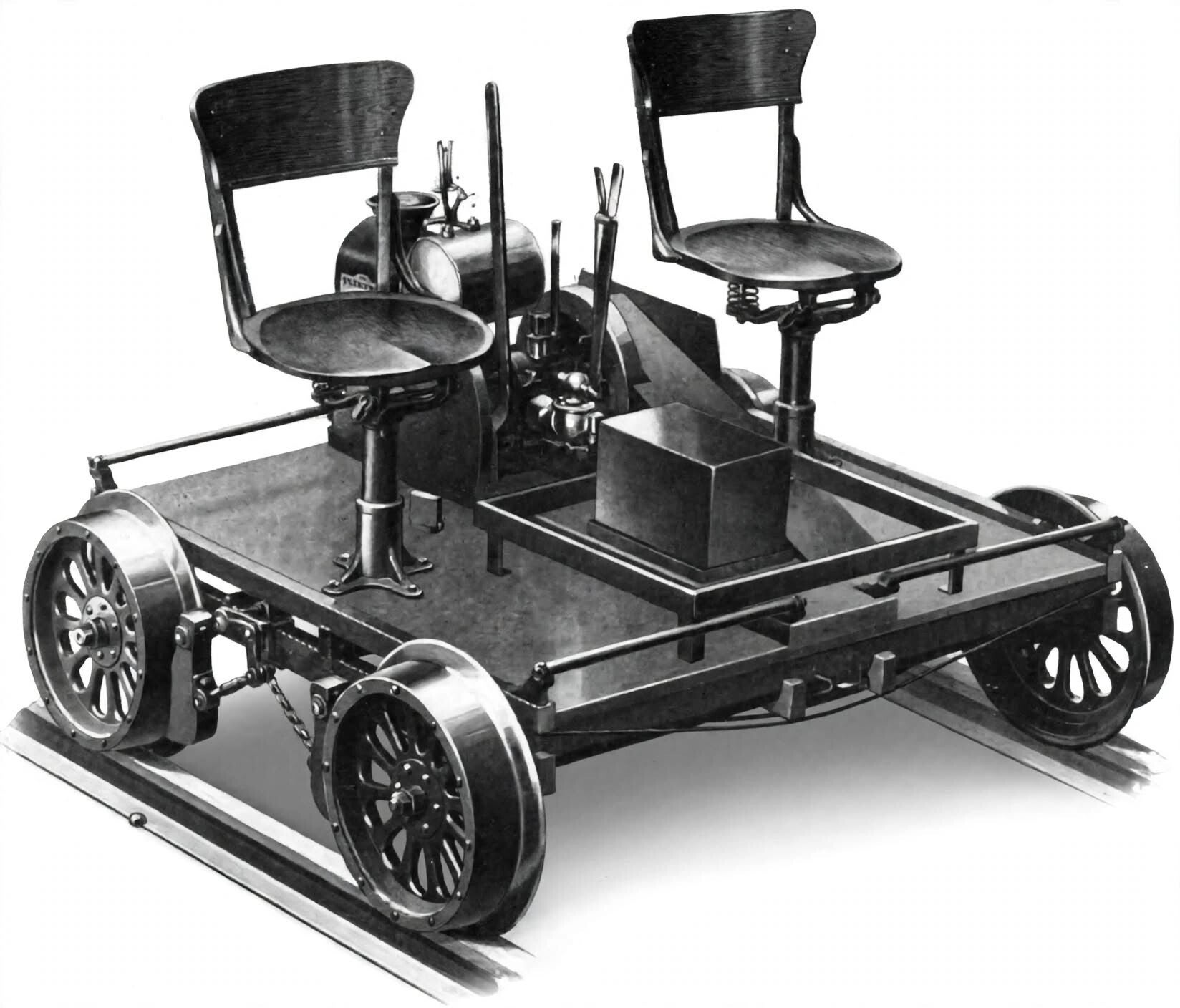
View of a "Roadmaster's Inspection Car" manufactured by Fairmont Gas Engine and Railway Motor Car Co., Fairmont Minnesota.
"The swivel office chairs face in any direction and the car is completely reversible, with ample power to overcome grades or wind pressure. This car is specially suited to track inspection, running evenly at all speeds from 3 miles per hour up, simply by moving the throttle. The engine is mounted over a loose wheel axle, making the other end easy to lift, and enabling the car to be turned in taking it from the track. The frame of the car is of standard car construction, with selected ash beams and sills, and the deck of the car is of elm. The wheels are 17 in. in diameter, wood filled, and with 1/4-in. tires; the axles are 1-1/4 in. and have boxes equipped with Hyatt roller bearings. Wood shoes engage the four wheels. The weight of the car complete is 600 lb." Date 1921.
(Photographer not identified, Public domain, via Wikimedia Commons)

Dimensions
Approximate dimensions of a common speeder car are given below. Due to the variety of base models and customization these are not fixed numbers. These values are from a Fairmont A4-D.
Rail gauge: 1,435 mm (4 ft 8+1⁄2 in) standard gauge (56.5 inches)
Weight: 3,500 pounds (1,588 kg)
Width: 64 inches (1,626 mm)
Height: 60 inches (1,524 mm)
Length: 9 feet 2 inches (2,794 mm) (~110 inches)
Wheel diameter: 16 inches (406 mm)
Floor height: 80–120% of the wheel diameter; 11 inches (279 mm)-17 inches (432 mm)
In popular culture
Sandy from Thomas & Friends: All Engines Go is an anthropomorphic rail speeder.
The 1965 Canadian comedy short film The Railrodder involves a cross-country journey by speeder.
Buster Keaton in "The Railrodder" (1965)
Produced by the National Film Board of Canada.
Directed by Gerald Potterton & Buster Keaton (uncredited).
Writing by Buster Keaton & Gerald Potterton.
Starring Buster Keaton.