

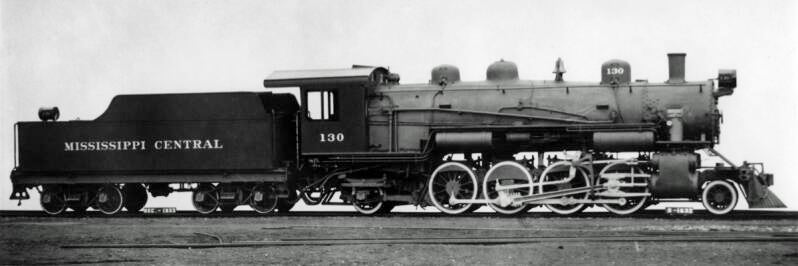
Mississippi Central 130, an ALCo Brooks 2-8-2 Mikado built December 1923. Builders photo.
(W. Lenheim Collection)

MISSISSIPPI CENTRAL - THE NATCHEZ ROUTE
The Mississippi Central Railroad (MCRR) (1904 - 1967) was a pivotal link in the development of timber and lumber industries in the U.S. State of Mississippi.
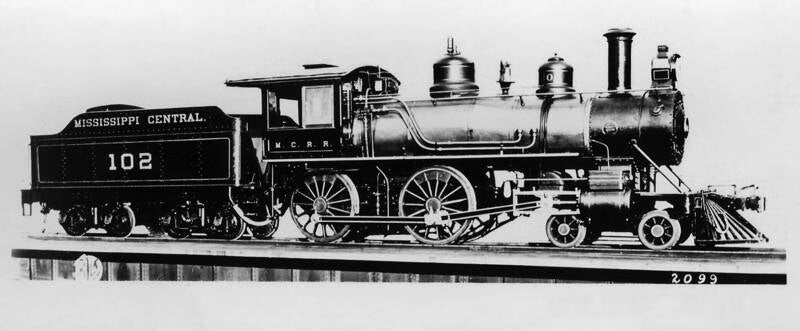
Mississippi Central 102, a 4-4-0 built by Baldwin in January of 1906. Builders photo.
(W. Lenheim Collection)
A Route of Growth and Timber
The Mississippi Central Railroad's story is deeply intertwined with the growth of the timber industry. Established on February 13, 1904, as an expansion of the Pearl & Leaf Rivers Railroad with the ambitious goal of reaching Natchez, Mississippi Central quickly became a vital artery for the region's burgeoning lumber operations. The railroad's commitment to progress was evident in 1908 when the highly anticipated first through passenger train ran from Hattiesburg to Natchez, pulled by engineer A. S. Trigg.
The J. J. Newman Lumber Company
The Mississippi Central was intrinsically linked to the vast J. J. Newman Lumber Company. By 1905, the company boasted an impressive 400,000 acres of timber holdings and an estimated capital investment of $26,000,000. The construction of another large sawmill in Bude in 1912, known as the Homochitto Lumber Co., further solidified the importance of the Mississippi Central. The railroad connected these significant milling operations, provided essential infrastructure for numerous logging branches, and offered efficient outlets for finished lumber. The J. J. Newman Lumber Company, Homochitto Lumber Co., and Mississippi Central were all under the umbrella of the United States Lumber Company, led by the influential Fenwick Peck.
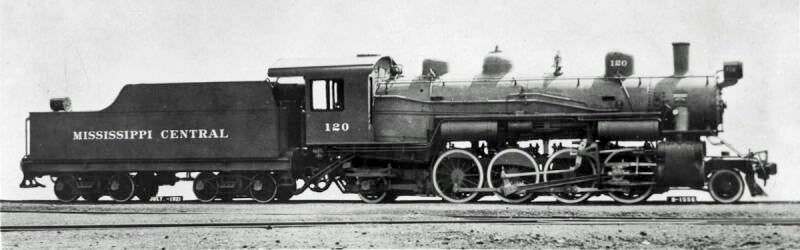
Mississippi Central 2-8-2 ALCo Brooks No. 120, built July 1921. Builders photo.
(W. Lenheim Collection)
Adopting "The Natchez Route"
In 1921, the Mississippi Central Railroad embraced a new identity, adopting the slogan "The Natchez Route." This slogan underscored the railroad's primary connection to the historic city of Natchez and highlighted its role in facilitating travel and commerce along this significant corridor. For railroad enthusiasts, this route represents a tangible piece of American industrial history, showcasing the symbiotic relationship between railroad expansion and the growth of major industries like timber. The line was out of business by 1967.
Additional Information
For more information about this line, be sure to visit: https://www.msrailroads.com/MSC.htm.
David Price and Tony Howe have done a fine job describing this railroad in depth and have provided a very nice selection of photos.

