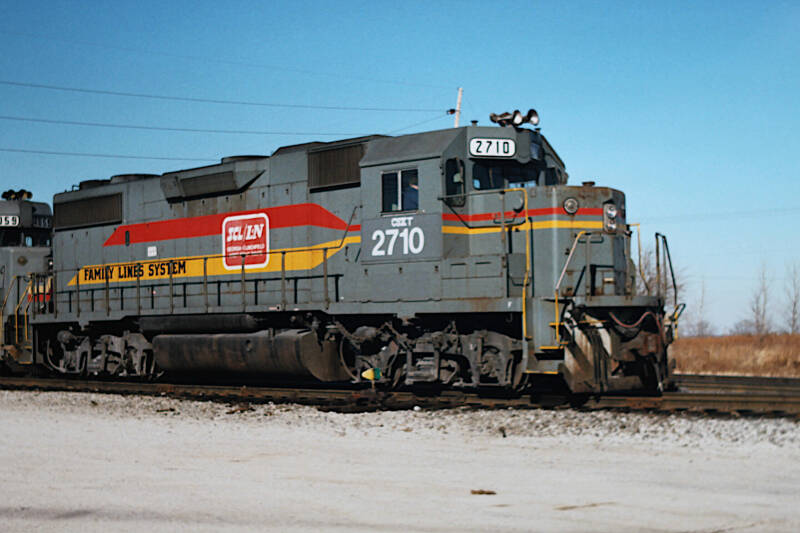
Family Lines System CSXT 2710, a GP38-2, at Danville, IL in November of 1987.
(Gary Todd, Public domain via Wikimedia Commons)
THE FAMILY LINES SYSTEM
The Family Lines System was a significant marketing name that united several prominent railroads.
A Union of Railroads
The Family Lines System was a marketing name adopted in 1972 by the Seaboard Coast Line Railroad and the Louisville & Nashville Railroad. This collaborative initiative also encompassed their subsidiaries: the Georgia Railroad, Clinchfield Railroad, Atlanta & West Point Railroad, and the Western Railway of Alabama. The last two of these operated under the distinctive nickname, the West Point Route. This unified branding strategy aimed to streamline operations and present a cohesive image to the public until the early 1980s.
Key Entities within the System
At the core of the Family Lines System were the Seaboard Coast Line Railroad (SCL) and the Louisville & Nashville Railroad (L&N). These two major carriers, along with their associated lines, represented a significant network. The inclusion of the Georgia Railroad (GARR), Clinchfield Railroad (SCL/L&N jointly owned), Atlanta & West Point Railroad (A&WP), and Western Railway of Alabama (WofA) under the Family Lines umbrella created a powerful presence in the southeastern United States. This strategic grouping allowed for integrated services and marketing efforts across a vast territory.
A Distinctive Identity
The Family Lines System offered a unique approach to railroad operations by consolidating under a single, recognizable brand. This was particularly appealing to rail enthusiasts and historians who could trace the integrated network and its distinct operational period. The system's focus on a unified identity set it apart from other railroad conglomerates of the era, highlighting a specific chapter in American railway history.