

Here is C&NW Crandall Cab 502 at Church Street, Evanston, IL in May 1980. Originally built in December 1962 as UP 913B.
(Photo by Marty Bernard, © 2025 Marty Bernard, Used by Permission, All Rights Reserved)
CRANDALL CAB LOCOMOTIVE
The Crandall Cabs were B-unit EMD E8s and EMD E9s rebuilt with homemade cabs for Chicago commuter service by the Chicago and North Western Railway.
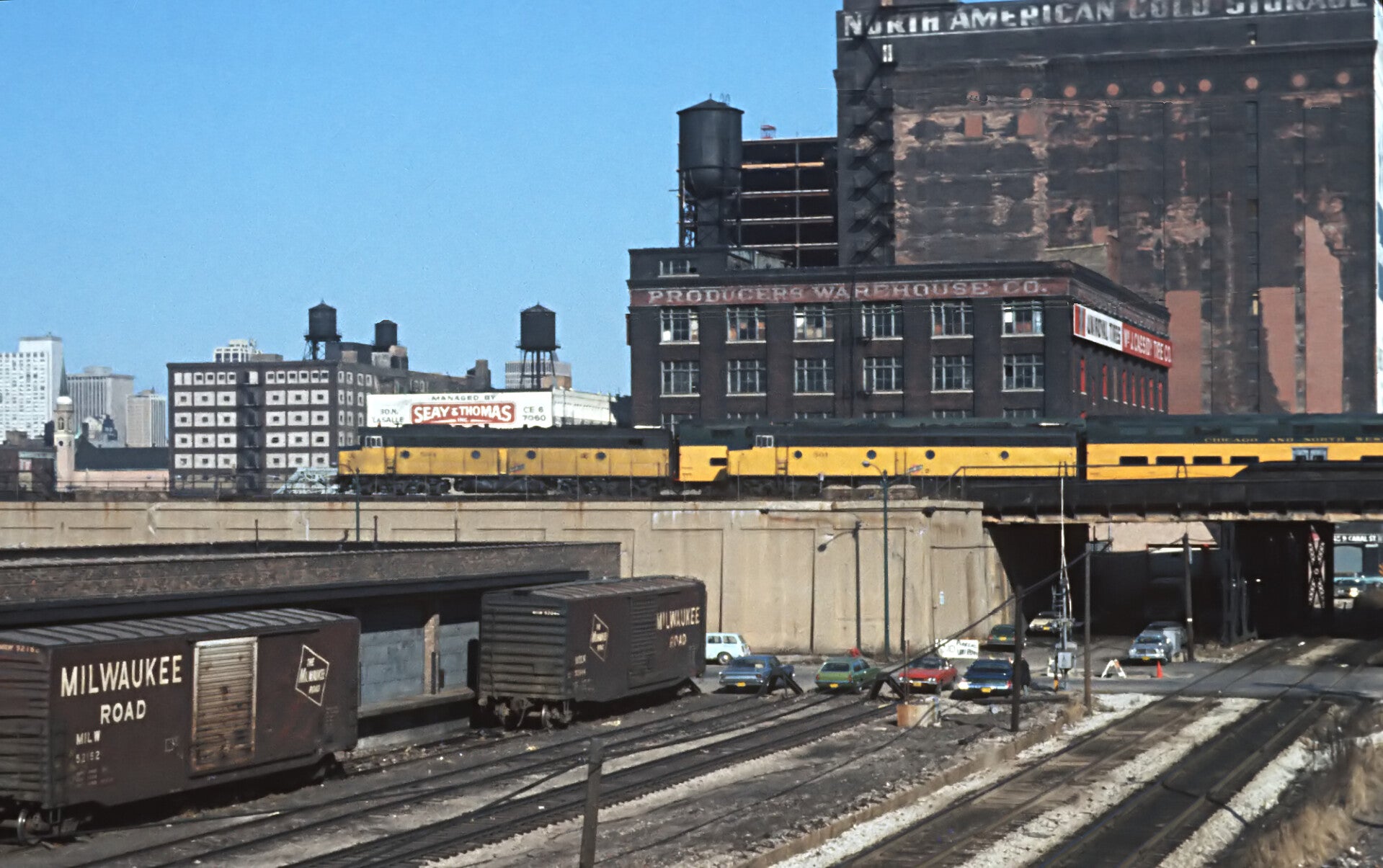
Two Crandall Cabs in One Picture: C&NW 501 and 506 taken about at N. Jefferson Street and the Milwaukee Road tracks looking east and a little north, Chicago, IL on
March 19, 1975. 501 was built 12/62 as UP 910B and 506 was built 5/55 as UP 962B. (Photo by Marty Bernard, © 2025 Marty Bernard, Used by Permission, All Rights Reserved)
"The Crandall Cab was an excellent, low-cost solution to make use of surplus Union Pacific E8B and E9B units. Easy to make in the CNW shop. All straight welds. No curves and certainly no compound curves. Probably fairly rigid in a grade crossing accident. Quite functional, fulfilling the need. But not particularly beautiful. CNW Assistant Superintendent of Motive Power, M. H. Crandall, designed them. The story goes he later passed away trying to start a stalled commuter unit during a frigid Chicago day. Died in the saddle, so to speak." - Marty Bernard
"And universally despised by the crews who operated them . . . typical of the Cheap & Nothing Wasted. They were noisy, had heavy vibration compared to a standard E (which was one of the smoothest riding locomotives I ever operated) and were very cold and drafty in the winter time. The horizontal sliding side windows vibrated violently in their frames at speeds over 50 MPH. The whole nose structure was fabricated from sheet metal and the collision posts were not substantial when viewed from inside the nose. Fortunately, they were never tested in a bad grade crossing accident. The Crandall Cabs were equipped with a more modern 26 automatic brake valve, than the 24RL brake valve featured on the other Es. Performance wise, they did plug the gap for the C&NW and I remember less troubleshooting required with the Crandalls, than with the other original Es. Anyway, a great photo (top) of a very unique locomotive taken from the sidewalk in front of Wieboldts. Thanks for sharing." - D.W. Davidson
Other complaints included that the side windows were made of Plexiglas and did not seal tightly, allowing wind and rain to enter the cab, as well as the thin sheet metal doing very little to suppress the noise from the extremely loud air horns mounted atop the cab roof.
