
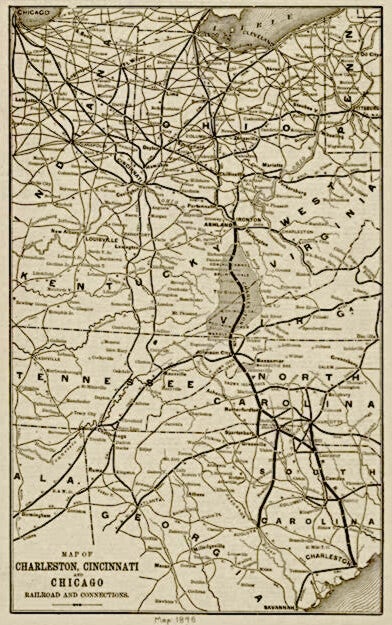
Map of the Triple C Railroad.
(W. Lenheim Collection)
CHARLESTON, CINCINNATI AND CHICAGO
The Charleston, Cincinnati and Chicago Railroad, informally known as the Triple C, was a Southeastern railroad that operated in the late 19th century.
The company was formed in 1886 with the idea of extending a rail line from Charleston, South Carolina, to Ashland, Kentucky, in an effort to mine coal and iron ore found in the Appalachians. Construction began at Rutherfordton, North Carolina, with rails being laid both north and south.
In 1890, major investor Baker Brothers & Co. failed and a court-appointed receiver was ordered for the Charleston, Cincinnati and Chicago. Three years later, the line was sold to its bondholders and a new corporation was established: The Ohio River and Charleston Railway.
The Charleston Cincinnati & Chicago Railroad (3Cs) was a bold, 19th-century "pioneer" project designed to bridge the gap between the Ohio River and the Atlantic Ocean. While the original company eventually failed, its vision laid the groundwork for one of the most successful mountain railroads in American history.
The Vision and Leadership
In the 1870s and 80s, the middle of the Eastern U.S. lacked a rail connection through the rugged Appalachian Mountains. General John T. Wilder, a Civil War hero and businessman, championed a "simple" vision:
- Build a line through the resource-rich Appalachians (coal, iron, and timber).
- Connect Ashland, KY (Ohio River) to Charleston, SC (Atlantic Ocean).
- Establish Johnson City, TN as the railroad’s headquarters.
Construction and Financial Failure
Chartered in 1886, construction began simultaneously in Kentucky, Tennessee, and North Carolina. However, the project faced immense hurdles:
- Geography: The route followed winding rivers through the mountains, leading to high operational costs and sharp curves.
- The Baring Panic: In 1890, the failure of the company’s primary backers, England’s Baring Brothers and Company, triggered a financial panic.
- Receivership: The 3Cs went into receivership with hundreds of miles of unfinished roadbed—often cited as the most in the history of the industry. It was sold in 1893 to the Ohio River & Charleston Railroad for just $550,000.
Legacy: The Clinchfield Railroad
The 3Cs' dream was eventually realized in the early 1900s by George L. Carter. Carter purchased segments of the original roadbed and added new construction to reduce grades and curves.
This evolution resulted in the Clinchfield Railroad (CC&O), which officially connected the Midwest to the Southeast in 1915. Though the 3Cs itself failed, its planned route was eventually operated by a partnership of three railroads:
- Chesapeake & Ohio Railway (Chicago to Elkhorn City, KY)
- Clinchfield Railroad (Elkhorn City to Spartanburg, SC)
- Atlantic Coast Line Railroad (Spartanburg to Charleston, SC)
The 3Cs Today
Remnants of the original 3Cs grade can still be seen today. Some portions are active spurs for CSX, while others are submerged, such as the grade visible in Boone Lake.
See Also:
Georgetown and North Carolina Railroad - predecessor of the Triple C
Ohio River and Charleston Railway
