
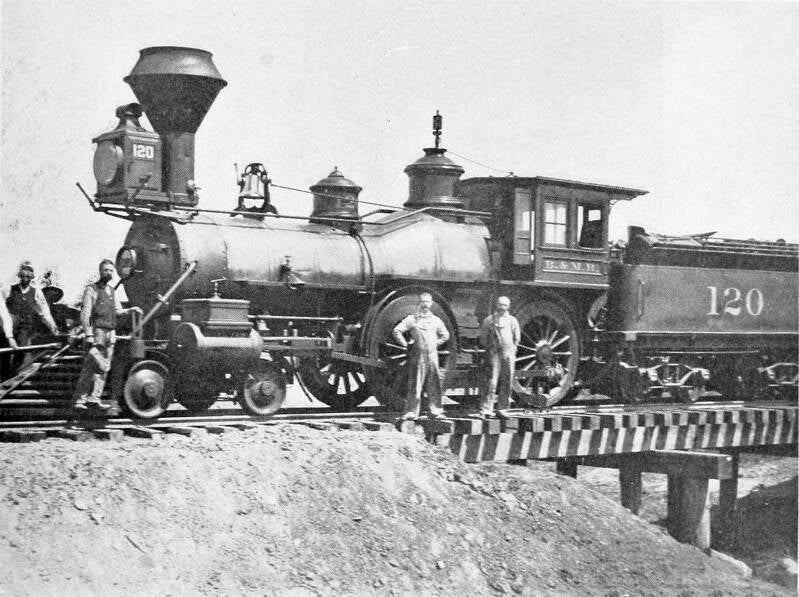
The first train to arrive in Broken Bow, Nebraska, August 26, 1886
(Internet Archive Book Images, No restrictions, via Wikimedia Commons)
BURLINGTON AND MISSOURI RIVER RAILROAD
The Burlington and Missouri River Railroad (B&MR) or sometimes (B&M) was an American railroad company incorporated in Iowa in 1852, with headquarters in Omaha, Nebraska. It was developed to build a railroad across the state of Iowa and began operations in 1856. It was acquired by the Chicago, Burlington and Quincy Railroad in 1872, and kept serving as its subsidiary.
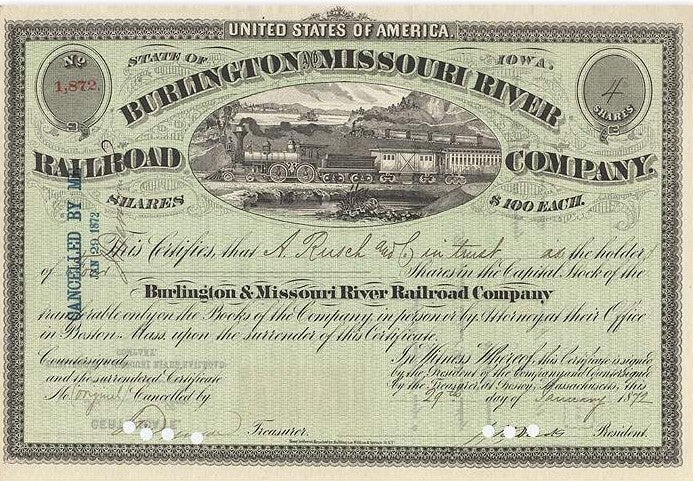
B&MR Stock certificate, cancelled 1872.
(Burlington and Missouri River Railroad, Public domain, via Wikimedia Commons)

Burlington and Missouri River Railroad roundhouse and shop in 1903 map in Alliance, Nebraska.
(https://www.loc.gov/item/sanborn05135_002/, Public domain, via Wikimedia Commons)
History
The Burlington and Missouri River Railroad was incorporated in Burlington, Iowa in 1852. It commenced operations on January 1, 1856, with only a few miles of track. In 1857 it connected to Ottumwa, followed by Murray in 1868. It finally reached the Missouri River in November 1869. It used wood-burning locomotives and wooden passenger cars.
After the Chicago, Burlington and Quincy Railroad (CB&Q) finished a bridge crossing the Mississippi River at Burlington, it connected to the Burlington and Missouri River Railroad. By 1868 the Burlington and Missouri River Railroad operated 13 locomotives and 429 cars, mostly freight, with net earnings of $299,850 in 1867. After the interest on loans, this meant a total net profit of $6,749.
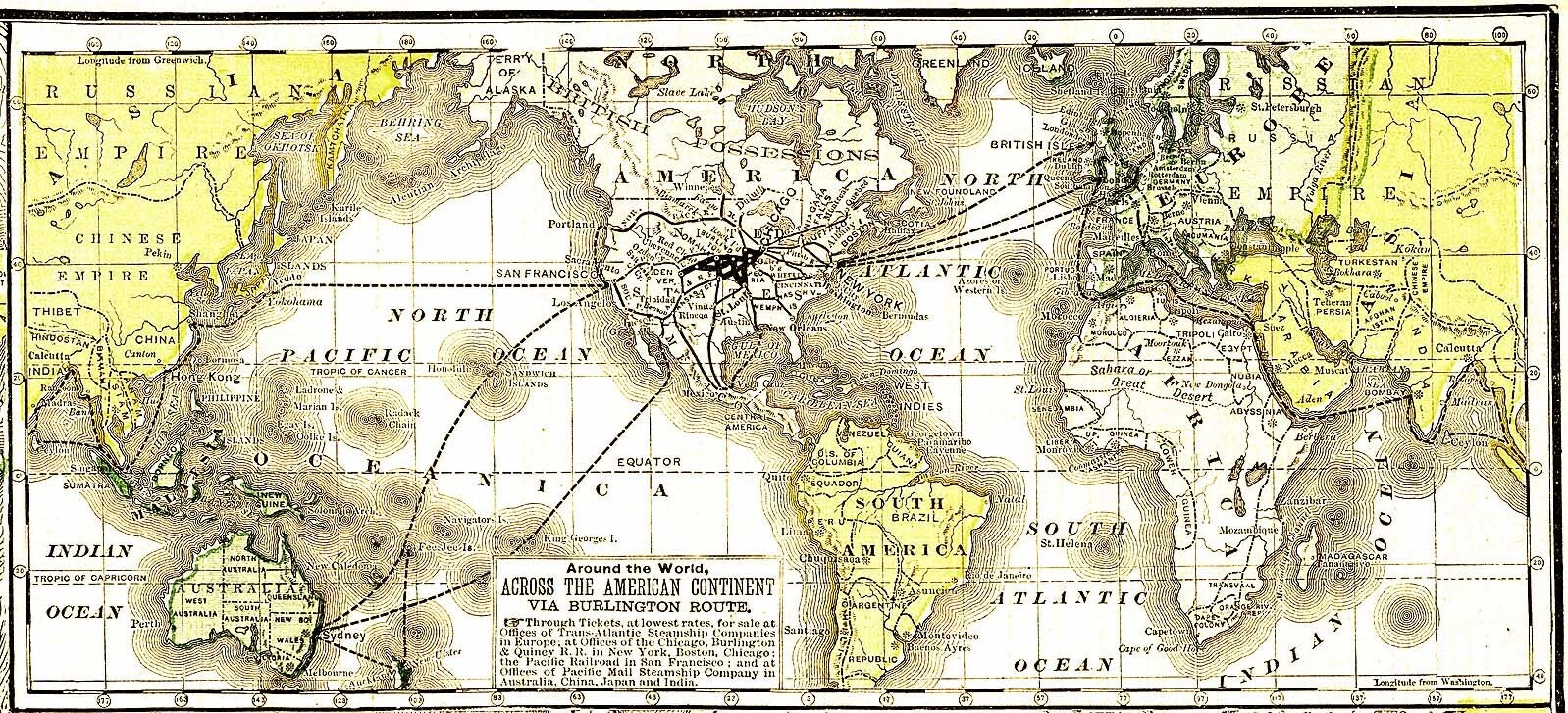
Map showing connections to harbors via the Burlington and Missouri River Railroad, 1888.
(Rand McNally and Company, Public domain, via Wikimedia Commons)
Sub-Branch
A sub-branch of the railroad was founded in Nebraska in 1869, with rails first entering the state in 1870 via Plattsmouth. That summer, the railroad reached Lincoln, the recently designated state capital. It later continued to lay rails westward and eventually joining with the Union Pacific Railroad on September 3, 1872, at Kearney; this linked traffic from southern Nebraska to the rest of the continent. That same year it began advertising "millions of acres of cheap land" as an incentive to prospective settlers to Iowa and Nebraska.
The Burlington and Missouri River Railroad was acquired by the Chicago, Burlington and Quincy Railroad in 1872. At the time, it had begun laying tracks to Denver, Colorado; this line was finished by the CB&Q ten years later.
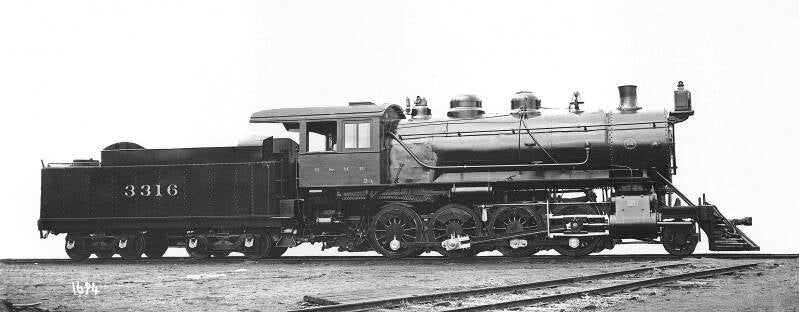
Burlington & Missouri River 2-8-0 Class D-4 3316 presumed at Philadelphia, Pennsylvania, sometime in 1903, photo by Baldwin Locomotive Works, Chuck Zeiler collection. This locomotive was built in 1903 for the Burlington & Missouri River (a subsidiary of the Chicago Burlington & Quincy) as class D-4 number 3316, renumbered in 1904 to CB&Q 3191, retired in June 1927. The B&MR received 2-8-0 class D-4 locomotives from both Baldwin (sub-classed D-4B) and Schenectady (Alco, sub-classed D-4A). A total of 100 D-4's were built, 75 by Alco and 25 by Baldwin, and at the time of their construction, they were the largest and heaviest locomotives on the Burlington system. They employed 12-inch piston steam valves actuated by Stephenson valve gear. (Baldwin Locomotive Works, Public domain, via Wikimedia Commons)
Subsidiary
After being acquired by the Chicago, Burlington and Quincy Railroad, the Burlington and Missouri River Railroad served as its subsidiary, operating several lines in the Black Hills, including those acquired when Chicago, Burlington and Quincy Railroad took over the Black Hills and Fort Pierre Railroad in 1901.

A B&MR Emigrant Boxcar at the Chicago Railroad Fair in 1948.
(Public domain via Wikimedia Commons)
